Self-employed home loans · Updated November 2026
Home loans for self-employed Australians: how to get approved
Being your own boss does not stop you buying a home. Lenders just ask for different proof of income. Use this checklist to get your paperwork ready.
Want the bigger picture first? See how lenders assess your application.
Quick answer
Most lenders want to see two years of personal and business tax returns, your latest notices of assessment and recent business financials. If you do not have those, some lenders offer low doc (alt doc) loans that accept an accountant’s letter, BAS or business bank statements instead.
Low doc loans can cost more, so a broker can help you compare your options before you apply.
1. Which path suits you?
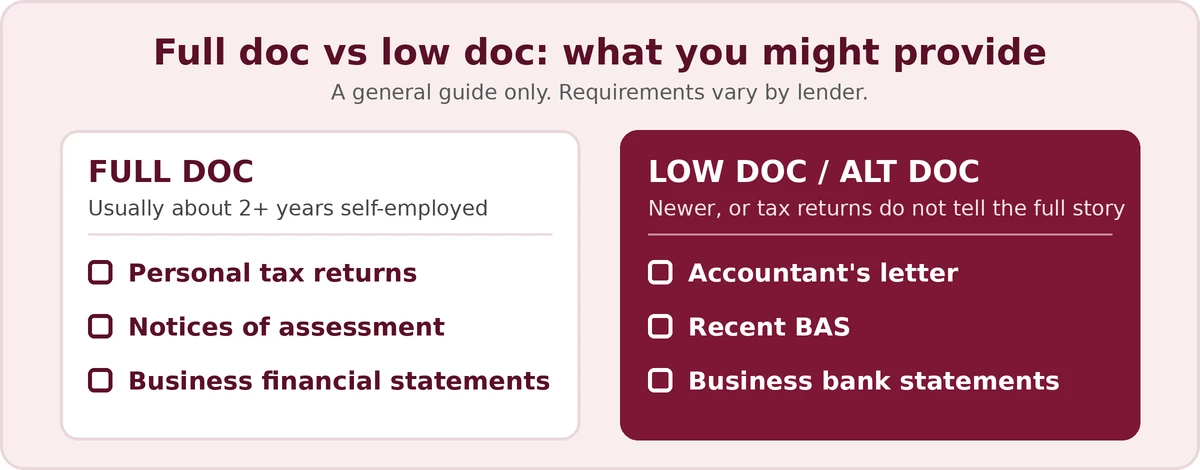
Lenders usually sort self-employed borrowers into two groups. Which one you fit depends mainly on how long you have been trading and what paperwork you can provide.
| Full doc loan | Low doc (alt doc) loan | |
|---|---|---|
| Who it suits | Self-employed for about two years or more, with tax returns lodged | Newer to self-employment, or tax returns do not show your full income |
| Typical evidence | Tax returns, notices of assessment, financial statements | Accountant’s letter, BAS or business bank statements |
| Trade-off | Usually more lender choice and competitive pricing | Fewer lenders, and rates and fees can be higher |
Requirements differ between lenders, so treat this as a guide, not a rule.
2. Your document checklist
Gather these before you speak to a lender. Not every lender asks for everything, but being organised speeds things up.
- Personal tax returnsUsually the last two years
- Notices of assessmentIssued by the ATO after you lodge
- Business tax returnsFor a company, trust or partnership
- Financial statementsProfit and loss, and balance sheet if you have one
- Recent BASIf you are registered for GST
- Bank statementsBusiness and personal accounts
- Debts and living costsCredit cards, loans and your regular expenses
- Deposit evidenceSavings history or other funds
Tip
Check any ATO balance before you apply. You can read about notices of assessment and business tax returns on the ATO website.
3. If you cannot provide full documents
Low doc loans (also called alt doc) accept alternative evidence of income. Lenders must still check that the loan is suitable and affordable for you, so they will not skip the checks.
Option 1
Accountant’s letter
Usually needs to be signed, dated and on letterhead, and state how long the accountant has acted for you. Some lenders have their own form.
Option 2
BAS statements
Recent business activity statements can show your turnover, if you are registered for GST.
Option 3
Bank statements
Some lenders accept several months of business bank statements to show income.
Once you have enough tax returns, you may be able to refinance to a full doc loan. A broker can tell you when that could be worthwhile.
4. Do and don’t before you apply
Do
- Lodge your tax returns on time
- Keep business and personal money separate
- Pay down credit cards and cancel the ones you do not use
- Talk to your accountant early
- Speak to a broker before you apply
Don’t
- Forget that big deductions lower the income lenders can use
- Apply to several lenders at once without advice
- Take on new debt or make big purchases first
- Leave ATO debts unresolved
- Guess what a lender needs
Related guides
How lenders assess applicationsWhat lenders look at.
Borrowing capacity: the hoopsWhy your limit may differ.
Deposit size and your rateHow your deposit affects options.
PAYG vs self-employed incomeAn example for doctors.
5. Frequently asked questions
Can I get a home loan if I am self-employed in Australia?
Yes. Many lenders lend to self-employed borrowers. They generally want to see a reliable income history, usually through tax returns, notices of assessment and business financials. If you do not have those yet, some lenders offer alternative documentation options.
How long do I need to be self-employed before I can apply?
It depends on the lender. Many mainstream lenders prefer two years of tax returns. Some specialist and non-bank lenders may consider borrowers who have traded for a shorter time if they can provide other evidence, such as BAS or business bank statements.
What is a low doc or alt doc home loan?
It is a loan for self-employed borrowers who cannot provide the usual full set of tax documents. Instead, income is supported by alternative evidence such as an accountant’s letter, BAS or business bank statements. Lenders must still check that the loan is suitable and that you can afford it.
Do low doc loans cost more?
They often do. Because the lender has less standard evidence to rely on, rates and fees can be higher than on a full doc loan. Many borrowers later move to a full doc loan once they have enough tax returns, but that depends on your circumstances and the lender.
Will lenders use my taxable income or my business income?
Lenders generally start with the income shown in your tax returns. Claiming larger deductions lowers your taxable income and can reduce what you can borrow. Some lenders may add back certain items, but their policies differ, so speak to a broker before you lodge or apply.
What documents will I need?
Commonly: your last two years of personal tax returns and notices of assessment, business financial statements, recent BAS if you are registered for GST, bank statements, and details of your debts and living expenses. Your broker will confirm what your chosen lender needs.
How much deposit do I need as a self-employed borrower?
It varies by lender and product. A larger deposit generally gives you more lender options and may reduce or avoid lenders mortgage insurance. Your broker can show you how different deposit sizes affect your options.
Self-employed and ready to buy?
Talk to CBM Mortgages about your documents, your options and which lenders may suit your situation.
Disclaimer: This article provides general information only and is not personal financial, legal, tax or credit advice. Lending policies, rates and fees change and vary by lender. Seek advice suited to your circumstances before acting.