
Borrowing capacity guide · Updated November 2026
How lenders assess your home loan application: income, expenses, debts and the buffer
Your borrowing capacity is not a number a bank looks up. It is the result of a lender’s own calculation, built from what you earn, what you spend, what you owe and a safety margin for higher rates. This guide shows how that calculation works and what you can do to improve it.
This is the hub for our borrowing capacity guides. Use the links further down to go deeper on HECS-HELP, pre-approval, credit cards and professional income, or see our first home buyer service page.
IncomeWhat you earn and how reliable it is
ExpensesLiving costs and spending habits
DebtsLoans, credit limits and HELP
BufferA margin for higher interest rates
Quick answer
Lenders estimate how much you can borrow by taking your reliable income, subtracting your living costs and existing debt commitments, and testing whether you could still make repayments if interest rates were higher. APRA expects banks and other authorised deposit-taking institutions to test at a buffer of at least 3 percentage points above the loan’s interest rate.
Each lender sets its own policy, so two lenders can reach different answers from the same facts. Pre-approval is a conditional indication of what a lender may be willing to lend, not a guarantee. A broker can compare how several lenders would treat your situation before you apply.
Jump to
What lenders assessBuffer and DTIDebts, credit cards and HELPBank statementsImprove your capacityPre-approvalRelated guidesFAQs
What lenders look at when you apply for a home loan
When you apply, the lender is trying to answer one question: can this borrower comfortably meet the repayments for the life of the loan? Six areas feed into that answer. Some are calculated directly into your borrowing capacity, and others affect whether the lender approves the application at all.
Income
How much you earn and how stable it is
Lenders review salary, regular overtime or shift pay, bonuses, rental income and other earnings. They also look at your employment type and how long you have been in the role. Permanent income is usually simpler to document than casual, contract or self-employed income. If you are self-employed, see our guide to home loans for self-employed Australians. If you are separating and want to keep the family home, see our guide to getting a home loan after separation, which covers how a lender assesses you on your own income.
Expenses
What it costs you to live
Lenders assess living costs for your household, including dependants, and compare what you declare with your bank statements and with benchmark measures of typical spending. Declaring your costs too low can cause problems later in the assessment.
Debts
What you already owe
Personal loans, car loans, other mortgages, buy now pay later accounts, credit cards and HELP repayments all reduce the income left over to service a new loan. The next section explains why credit cards matter even when you do not use them.
Credit history
How you have handled credit
Your credit report shows repayment history, defaults and recent applications. Moneysmart notes that defaults and repayments more than 14 days overdue can lead to a loan being declined, and that applying for several loans in a short period can look bad on your credit report.
Deposit
Your savings and the loan-to-value ratio
The loan-to-value ratio (LVR) compares the loan with the property’s value. A larger deposit means a lower LVR, which usually gives you more options. Lenders also like to see savings built up over time, not just a single large deposit.
Property
The loan and the security
The lender values the property it will hold as security. Property type, location, whether you will live in it or rent it out, and the loan structure can all affect the outcome and the lender’s policy limits.
Lender policies differ and change over time. This guide is a general overview only.
The serviceability buffer and debt-to-income limits
Two regulatory settings shape how banks assess borrowers. Neither one is a number you can choose, but understanding them explains why a lender’s answer is lower than a simple repayment estimate at today’s rate.
The 3 percentage point buffer
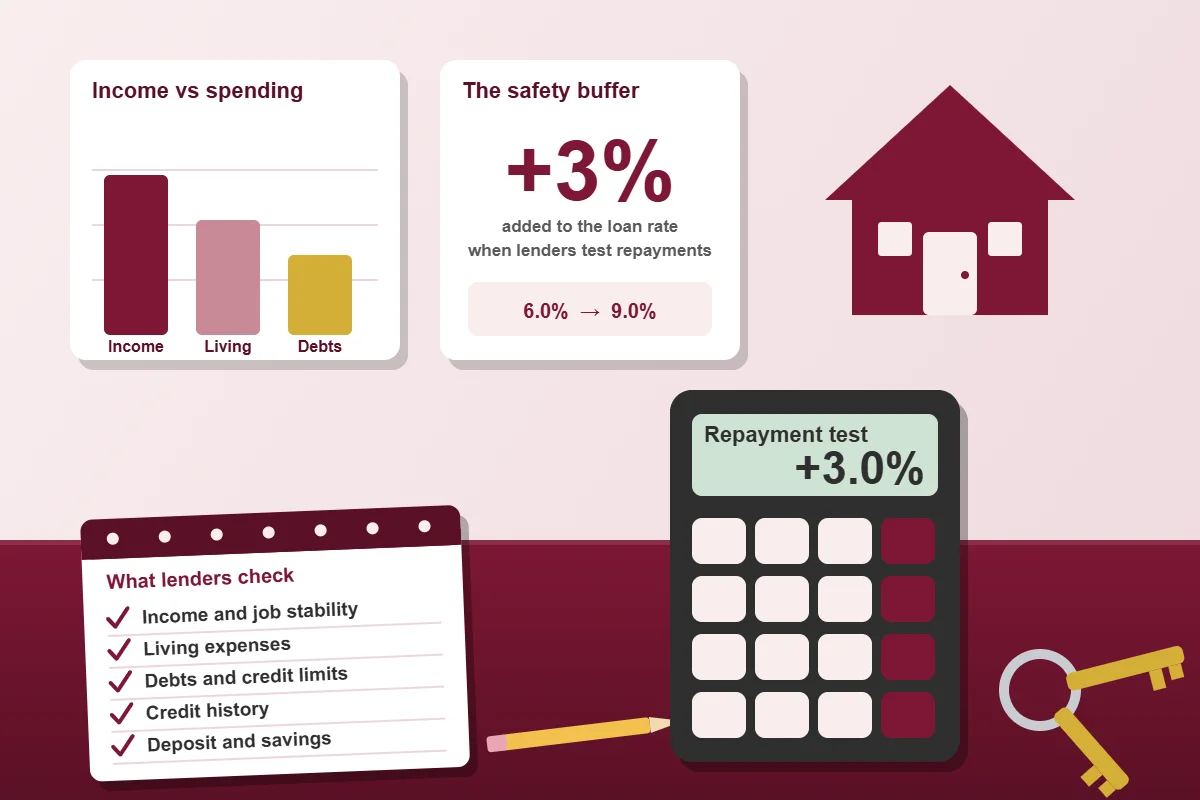
When a lender tests whether you can afford a loan, it does not use the interest rate you will pay. APRA expects lenders to assess repayments at a rate at least 3.0 percentage points above the loan’s interest rate. On 28 May 2026, APRA said the buffer would remain at 3 percentage points. Read APRA’s statement.
In practice, if a loan’s interest rate is 6 per cent, the lender tests it at 9 per cent. The 6 per cent here is only a number to show how the buffer works, not a current rate.
| Setting | What it means for borrowers |
|---|---|
| Serviceability buffer | Repayments are tested at a rate at least 3 percentage points above the loan’s interest rate. It lowers the amount you can borrow compared with a calculation at the loan’s actual rate. |
| Debt-to-income (DTI) limits | Since 1 February 2026, each bank can lend up to 20 per cent of its new owner-occupied loans, and 20 per cent of its new investor loans, at a DTI of six times income or more. APRA said on 28 May 2026 that the limits remain unchanged and that high-DTI lending is well below them. Certain loans, such as construction of new dwellings, are exempt. |
| What this means for you | The DTI limits apply to a bank’s overall lending, not to you personally. They matter most if you plan to borrow a very large amount compared with your income, and lenders may also apply their own limits. |
Debt-to-income compares your total debts with your income. APRA sets out the precise definition in its reporting standard ARS 223.0, and individual lenders may measure it differently in their own policies.
Debts, credit card limits and HELP
Existing debts are one of the most direct levers on your borrowing capacity, because every repayment commitment reduces the income available for a new loan.
Credit cards: the limit counts
Lenders generally assess a credit card on its limit, not only on the balance you currently owe, because the limit is what you could borrow. The percentage applied differs between lenders. If you have a card you rarely use, reducing the limit or closing the account before you apply may improve your result. Our guide to how credit card limits affect home loans explains this in more detail.
HELP and HECS debt
A HELP debt is not a credit problem, but compulsory repayments come out of your pay and reduce what is left to service a loan. APRA has given lenders flexibility to leave HELP repayments out of a serviceability assessment where the borrower will be largely unaffected over the loan term, with “within 12 months” given as an example of a reasonable timeframe. Our HECS-HELP and home loan guide covers this in full.
Illustrative HELP example
The ATO’s minimum repayment income threshold is $67,000 for 2025-26 and $69,528 for 2026-27. For 2026-27, the first repayment band charges 15 cents for each dollar of repayment income over $69,528. On an assumed repayment income of $80,000, that is $10,472 over the threshold, or about $1,570.80 a year in compulsory repayments. This example is for illustration only, and your own repayment income and rate may differ.
What lenders notice on your bank statements
Your declared expenses are checked against your actual spending. Statements show a lender how you really live, and patterns that are easy to explain in person can raise questions on paper. These are common examples.
Buy now, pay later
Regular repayments to buy now, pay later providers can show up as ongoing commitments, even where each account feels small. Lenders may ask you to list them and may count them as debts.
Unclear payment descriptions
Payments listed only as a generic PayPal reference or an unfamiliar merchant code do not tell the lender what the money was for. Be ready to explain what they are, or have the details to hand.
Frequent cash withdrawals
Regular cash withdrawals are hard to trace, so a lender may ask what the cash was used for. Keeping spending visible on your statements makes your living costs easier to verify.
Tip: explain it before they ask
Tell your broker about anything unusual in your statements before the application is lodged. A short, honest explanation up front usually works better than a query from the lender partway through.
How to improve your borrowing capacity
Capacity can move in either direction depending on what you do in the months before you apply. These steps are the ones that tend to make a difference.
Reduce what lenders count against you
Lower or close credit card limits you do not need
Pay down or clear personal loans, car loans and buy now, pay later accounts
Avoid applying for several credit products in a short period
Check your credit report for errors before you apply
Strengthen what lenders can verify
Keep payslips, tax documents and employment details up to date
Show a consistent savings record over several months
Keep day-to-day spending visible on your statements
Speak with a broker before you apply, so the application suits the lender
You can get a general estimate from our borrowing power calculator. It is a starting point only, because it cannot apply any single lender’s policy. If your income includes shift pay or irregular hours, our income annualisation calculator can help you estimate a steady figure.
Pre-approval: what it is and what it is not
Pre-approval is a lender’s conditional indication of how much it may lend you. According to Moneysmart, it lasts three to six months, shows you are eligible to apply for a loan up to a certain amount and does not commit you to a loan. When you ask for it, the lender will ask for evidence of your current financial situation to assess your ability to repay.
Because it is conditional, final approval still depends on the property, a valuation and the lender’s checks at the time. Our guide to the home loan approval process walks through each stage from pre-approval to settlement. For general information, see Moneysmart’s guide to buying a house.
Related borrowing capacity guides
HECS-HELP and your home loanHow lenders treat a study debt.
Home loans for nursesShift pay, casual and agency income.
Home loans for doctorsPAYG and self-employed income.
Borrowing power for medical specialistsHow specialist income is assessed.
Credit cards and home loansWhy the limit matters.
The home loan approval processFrom pre-approval to settlement.
Borrowing power calculatorEstimate what you could borrow.
Mortgage serviceability explainedThe factors behind your borrowing capacity.
Frequently asked questions
How do lenders work out how much I can borrow?
Lenders start with your reliable income, subtract your living costs and the repayments on your existing debts, and then test whether you could still afford the new loan at a higher interest rate. Each lender uses its own policy, so the result differs between lenders even when your finances are the same.
What is the serviceability buffer?
It is the margin lenders add to the interest rate when they test your repayments. APRA expects banks and other authorised deposit-taking institutions to use a buffer of at least 3 percentage points above the loan’s interest rate, and it confirmed on 28 May 2026 that the buffer remains at 3 percentage points.
Does HECS-HELP debt reduce how much I can borrow?
Usually, yes, because compulsory repayments reduce the income left to service a loan. APRA has given lenders flexibility to leave HELP repayments out of the assessment where the borrower will be largely unaffected over the loan term, for example when the debt will be repaid within 12 months. Whether and how they use that flexibility is up to each lender.
Do credit card limits affect my borrowing capacity even if I never use the card?
They can. Lenders generally assess a credit card on its limit rather than only on the balance, because the limit is what you could borrow. The percentage they apply varies by lender. Reducing a limit you do not need, or closing the card, before you apply can improve the result.
What do lenders look for on my bank statements?
They compare your actual spending with the living costs you declared, and they look for regular commitments such as buy now, pay later repayments. Payments with unclear descriptions and frequent cash withdrawals can also prompt questions, so be ready to explain them.
How long does pre-approval last, and is it a guarantee?
Moneysmart says pre-approval lasts three to six months and does not commit you to a loan. It is not a guarantee of final approval, because the lender still has to assess the property and verify your details when you apply for the actual loan.
What is a debt-to-income limit, and does it affect me?
Debt-to-income compares your total debts with your income. Since 1 February 2026, APRA has allowed each bank to write up to 20 per cent of its new owner-occupied loans and 20 per cent of its new investor loans at a debt-to-income ratio of six times or more. The limits apply to the bank’s lending overall, so they matter most if you plan to borrow a very large amount compared with your income.
How can I improve my borrowing capacity before I apply?
Reduce or close credit card limits you do not need, pay down personal loans, car loans and buy now, pay later accounts, avoid applying for several credit products at once, and keep your income documents and savings record up to date. Speaking with a broker before you apply helps you choose a lender whose policy suits your situation.
Want to know how a lender would read your numbers?
Talk to CBM Mortgages about your income, expenses and debts, and which lenders may suit your situation.
Disclaimer: This article provides general information only and is not personal financial, legal, tax or credit advice. Lender policies, regulatory settings and eligibility criteria vary and can change. Seek advice suited to your circumstances before acting.
Written by Craig McDonald · Updated November 2026 · CBM Mortgages, Sydney mortgage brokers · Craig in the news